Roof Surface Temperature Is Not Air Temperature

In discussions about roofing, energy performance, and urban heat, one misunderstanding recurs: the temperature measured on the roof surface is often treated as if it were the ambient air temperature above the roof. It is not the same, and confusing the two can lead to poor policy and design decisions.

For building owners, designers, policymakers, and industry professionals, this distinction matters. Any surface in direct sun, including a roof membrane, can become hotter than the surrounding air. At the same time, the air a couple of feet above that surface may be cooler, influenced by wind, shading, humidity, building geometry, surface albedo, time of day, and the movement of heat away from the surface.

This issue also has practical implications for rooftop mechanical systems. The air intake area of many HVAC and other rooftop units is often located about 18 inches above the roof surface. That means thermal conditions near the roof can affect equipment operation, design assumptions, maintenance planning, and system performance. Surface temperature and intake-air temperature should not be assumed to be the same value.

It also explains why roof surface temperature should be used carefully when evaluating claims about building performance or urban heat mitigation. A hot roof surface does not necessarily mean the surrounding air is equally hot. A cooler roof surface does not automatically produce a meaningful reduction in neighborhood-scale air temperatures.

Several studies have looked at this difference. Research by Elizabeth Grant found that roof color can strongly affect roof surface temperatures, while the effect on adjacent air temperatures is often smaller, more variable, and dependent on site-specific conditions. That matters because surface temperature changes and air temperature changes should not be treated as interchangeable outcomes.

Other research reached similar conclusions from a different angle. Studies led by Travis Lindsey for the Copper Development Association on rooftop electrical conduit systems examined temperatures in conduits exposed to direct sunlight. Those investigations documented how solar exposure can elevate temperatures at or near rooftop surfaces well beyond standard ambient conditions. In practical terms, this reinforced a longstanding engineering reality: rooftop environments can experience localized heat conditions that differ materially from reported air temperature data.

Research presented by Samir Ibrahim at Carlisle also examined where heat goes within roof assemblies and surrounding conditions. That work showed that heat in roofing systems moves in multiple directions. We know that some is reflected, some absorbed, some stored, some transferred into the building, and some released back to the atmosphere over time. Roof performance is not captured by a single temperature reading.

Roof color and albedo are part of this conversation, but only part of it. Highly reflective white surfaces can reduce solar absorption and lower peak surface temperatures in certain climate zones and under certain conditions. Darker surfaces may behave differently depending on insulation levels, climate zone, time of year, assembly design, and whole-building performance goals. The key point is not that one attribute alone determines success; roof systems should be evaluated holistically.

This is especially important when policymakers or roofing professionals focus narrowly on visible surface temperature or assume that lower surface temperatures automatically solve broader urban heat concerns. Cities are shaped by many interacting variables, including pavement, vegetation, shade, traffic, density, building height, waste heat, and weather patterns. Roofs matter, but they are one part of a larger system.

That is why COSUR supports product-neutral, science-based evaluation of roof systems and roofing assemblies. Good policy should distinguish between roof surface conditions, rooftop microclimates, whole-building energy performance, durability, resilience, lifecycle impacts, and broader urban environmental outcomes. These issues are related, but they are not the same.

More research is warranted, especially field-based research that separates the effects of roofs from roads, parking areas, tree canopy, and other urban surfaces. But even with the information already available, there is reason to pause before making broad assumptions based solely on roof surface temperatures.

Better decisions begin with better definitions, better measurements, and a clearer understanding of what is actually being measured.

Further Reading

Finding Balance: The Next Chapter in Low-Slope Roof Design

Published in Interface, the technical journal of IIBEC, March 2026

Read what the author, Jason Wilen, has to say about this topic.

Achieving long-term performance in low-slope roof systems requires balance. Not balance between competing preferences, but balance across the full set of technical, environmental, and code-driven variables that define how a roof system performs over time. As this article highlights, challenges arise when designers, policymakers, or project teams prioritize a single attribute, such as reflectivity, first cost, or insulation levels, without fully accounting for the interdependencies within the roof assembly.

The Coalition for Sustainable Roofing (COSUR) advances a similar principle through its focus on holistic roof system design and sustainable roofing assemblies. Roofs are not individual products or isolated decisions. They are integrated systems that must simultaneously address durability, energy performance, moisture management, structural requirements, constructability, and long-term service life. When any one variable is elevated above the others, unintended consequences often follow, including reduced performance, shortened service life, or conflicts between building and energy code requirements.

This article reinforces the need to move beyond prescriptive, single-attribute approaches and toward performance-based strategies that recognize the complexity of roof systems. A balanced approach, grounded in science and field performance, enables designers and policymakers to achieve resilient, sustainable outcomes that align with the long-term interests of building owners and the broader built environment.

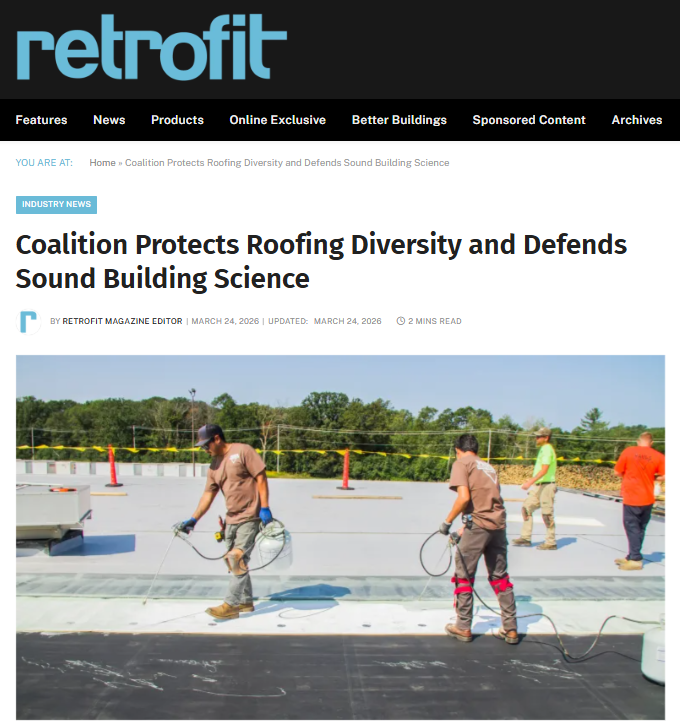
Coalition Protects Roofing Diversity and Defends Sound Building Science

A broad coalition of roofing industry organizations has successfully defeated Mississippi House Bill 1730, legislation that would have imposed a mandatory minimum 3:12 roof slope on all new public buildings constructed in the state.  

The measure, which passed the Mississippi House of Representatives before stalling in the state Senate, would have effectively prohibited low-slope roofing systems on public construction projects and eliminated proven, cost-effective roofing solutions used on schools, hospitals, government buildings, and other public facilities nationwide. 

“This outcome proves the power of a united industry speaking with one voice,” said Ellen Thorp, CAE, president and managing director of Coalition for Sustainable Roofing (COSUR). “Low-slope roofing systems have a decades-long track record of performance on public buildings. This legislation was well-intentioned but based on a fundamental misunderstanding of building science, and we’re grateful the Mississippi Senate recognized that.” 

“Low-slope roofing systems are a staple of commercial and public construction in Mississippi,” said Christee Roberson, owner and president of Graham Roofing Inc. in West Point, Miss. “This bill would have tied the hands of architects, building owners, and contractors, and driven up costs for taxpayers in the process. We’re glad the industry mobilized quickly and effectively to make sure that didn’t happen.” 

The Coalition for Sustainable Roofing (COSUR) led the advocacy effort, working in close coordination with the EPDM Roofing Association (ERA), the National Roofing Contractors Association (NRCA), the International Institute of Building Enclosure Consultants (IIBEC), the Asphalt Roofing Manufacturers Association (ARMA), the Polyisocyanurate Insulation Manufacturers Association (PIMA), the Single Ply Roofing Institute (SPRI), the Mississippi Roofing Contractors Association, and approximately a dozen additional roofing-related organizations and industry partners. 

Original Source: https://retrofitmagazine.com/coalition-protects-roofing-diversity-and-defends-sound-building-science/

Ellen Thorp Appointed Chair of NIBS Consultative Council

Thorp brings extensive experience in sustainable roofing, building resilience, and advancing environmentally responsible practices

Published in Building Enclosure on December 3, 2025

The Coalition for Sustainable Roofing (COSUR) announced that Ellen Breipohl Thorp, CAE, president and managing director of COSUR, has been appointed Chair of the Consultative Council of the National Institute of Building Sciences (NIBS). Her term will continue through September 30, 2027.  

The NIBS Consultative Council brings together leading voices from across the built environment to identify challenges, recommend solutions, and inform national priorities. The Council serves as a bridge between industry experts and policymakers, making recommendations directly to the executive and legislative branches of government. As Chair, Thorp will guide dialogue and advance actionable solutions that strengthen the nation’s buildings and infrastructure.  

“The Consultative Council was envisioned by Congress as the nation’s premier industry advisory council for America’s built environment,” said George Guszcza, CEO of NIBS. “Ellen Thorp is a dynamic leader and brings broad experience, expertise, and a collaborative spirit that will help drive innovation, resilience, and safety across our built environment.” 

Thorp brings extensive experience in sustainable roofing, building resilience, and advancing environmentally responsible practices. Under her leadership, COSUR has driven initiatives to promote energy-efficient, durable, and environmentally friendly roofing solutions across the United States.  

“I am honored to serve as chair of the Consultative Council and to represent the building community in addressing challenges that affect both the environment and our nation’s infrastructure,” said Thorp. “I look forward to collaborating with industry leaders, policymakers, and innovators to advance sustainable solutions that protect and strengthen our built environment.”  

KEYWORDS: building scienceinfrastructureleadershipNIBS (National Institute of Building Sciences)roofingsustainable design

No Clear Vision Yet of Tariffs’ Impact U.S. Roofing Industry

By Ellen Thorp Published in Building Enclosure on April 25, 2025

The U.S. roofing industry is grappling with significant challenges following the announcements of new tariffs. Faced with a lack of clarity regarding their scope and application, new tariffs have the potential to affect the cost and supply chain of essential materials like steel, aluminum, carbon black and various fasteners.

Contrary to popular belief, it’s not foreign exporters or overseas manufacturers who bear the cost of tariffs. The financial burden lands on domestic importers. Tariffs are only applied when goods arrive at a U.S. port of entry, at which point the importer—usually a U.S.-based manufacturer—is responsible for paying the duty directly to the federal government. That upfront cost is often passed along the supply chain, triggering a ripple effect throughout the broader economic system.

Following a flurry of tariff activity, on April 9, President Trump issued a temporary pause on escalating tariffs for nearly 60 countries, including all members of the European Union. Despite this pause, U.S. tariff rates have climbed to their highest point in nearly nine decades.

This country-specific reprieve presents a small but valuable window for businesses to assess the implications of the new import duties and strategically plan for what may lie ahead. As the reach of these tariffs expands, the ripple effects across roofing continue to emerge. In this evolving landscape we take a closer look at the most urgent challenges roofing professionals should anticipate in the wake of new tariffs.

Uncertainty is the Word of the Day

With frequent changes to targeted countries and tariff rates, manufacturers are struggling to assess the impact on their operations. Federal guidance remains unclear, leaving questions about which materials and countries are affected, and whether tariffs apply to raw materials, finished products, or both. This uncertainty is disrupting procurement strategies and complicating pricing for manufacturers, designers, and consultants across the roofing industry.

This ambiguity is a shared sentiment of all manufacturers. In its first quarter survey the National Association of Manufacturers indicated that “concerns among manufacturers run high over trade uncertainties and increasing raw material costs. In fact, trade uncertainties surged to the top of manufacturers’ challenges, cited by 76.2% of respondents—up 20 percentage points from the last quarter of 2024 and 40 points from the third quarter of 2024. Increased raw material costs were the second most cited concern, noted by 62.3% of respondents.”

Unclear Process

Traditionally, new U.S. tariffs followed a structured, transparent process. A formal proposal—either from the executive branch or through congressional legislation—is followed by a public comment period to assess economic impact. Agencies may then hold hearings for industry feedback before reviewing and adjusting the tariff list. Once finalized, the tariffs are announced with an effective date, giving businesses time to prepare.

The administration’s announcements, bypassing the usual regulatory process, have created confusion across the industry, leaving manufacturers and contractors uncertain about how to raise their concerns. This likely contributed to the strong turnout at the NRCA’s recent Roofing Day on Capitol Hill, which saw its highest attendance since before the COVID-19 pandemic.

Additionally, many roofing industry associations are advocating on various issues,including tariffs, though details on their efforts for exemptions from Section 232 steel and aluminum tariffs are scarce. During the pandemic, roofing materials were classified as essential and granted tariff exemptions. The industry must continue pushing to maintain unrestricted access to these products, as our past success in securing special considerations shows the power of effective lobbying.

Challenges in Domestic Production Unlikely

While some hope that tariffs will spur more U.S.-based manufacturing, the blanket application of the 2025 tariffs skip traditional steps, limiting opportunities for discussion on material carve-outs not available domestically. For example, roofing materials such as carbon black used in EPDM and asphalt shingles, mostly comes from China, Korea and Europe. Without an existing robust domestic supply chain for these materials, manufacturers are left with limited options to mitigate the impact of the tariffs.

The 145% tariff on Chinese imports, in particular, may bring considerable price instability to critical materials. For manufacturers that depend on consistent material costs to plan production and manage budgets, this unpredictability poses a serious challenge. The resulting volatility may also complicate efforts to secure long-term contracts with fixed pricing—especially where long-term forecasting and planning are essential.

Implementing changes in the industry takes considerable time. Setting up facilities to produce raw materials—such as polymers or carbon black, would require at least two to three years from the time funding is approved. Given the current market uncertainty, it’s unlikely that many companies will commit to these investments until the tariffs are finalized.

Reciprocal Concerns and Some Promising Signs Up North

We also have concerns about reciprocal tariffs, as they will significantly impact manufacturers across multiple fronts. While much of the attention has been on the cost increases tied to raw materials, the broader implications shouldn’t be overlooked. These tariffs could lead to reduced demand for U.S. made products abroad, making it harder for our manufacturers to compete in international markets. The combined effect of higher input costs and restricted export opportunities poses a serious threat to the industry’s growth and global competitiveness.

As announced by the Minister of Finance, the United States Remission Order (2025) came into effect on April 16, offering temporary tariff relief on U.S. goods imported by or for Canadian entities in sectors such as public health, healthcare, public safety, and national security. The Order also applies to goods essential for Canadian manufacturing, processing, or food and beverage packaging. 

This measure supports businesses and organizations vital to Canadians’ well-being by easing supply chain pressures and enhancing competitiveness. The relief is valid for goods imported between April 16 and October 15, 2025, and retroactively applies to imports since March 4. Tariffs can be waived at import or refunded if already paid.

Call for Collaborative Solutions

Building products manufacturers join other industry leaders in calling on the administration to work closely with manufacturers to tackle these growing challenges. Some of the tariffs may have long-term value to the U.S. economy. A more strategic, coordinated effort could focus on pinpointing essential materials that cannot be produced domestically and finding ways to facilitate their import without excessive tariffs. Taking such steps would help bring stability to the roofing sector and maintain access to critical supplies.

The 2025 tariffs have brought uncertainty to the U.S. roofing industry and itsmanufacturers. While these tariffs may be beneficial in some cases, with unclear guidelines and limited domestic production of critical materials, both manufacturers and contractors are facing mounting challenges. To reduce the negative impact and help stabilize the industry, a more transparent and coordinated strategy—built on collaboration between the administration and industry stakeholders—is urgently needed.

KEYWORDS: aluminumeconomic analysisfastenersroofingsteeltariffs

Tennessee Legislature Exempts State from White Roof Mandate

Tennessee lawmakers have advanced legislation that reflects what works for Tennessee’s climate and construction practices, rejects one-size-fits-all mandates not grounded in Tennessee-based research, and supports local businesses. The bill, signed on April 3rd, 2025, exempts the state from a mandate requiring highly reflective white roofs on commercial buildings.

Key Details

  • The legislation exempts Tennessee from a small section (0.01%) of the 2021 International Energy Conservation Code (IECC) requiring minimum reflectance levels on low-sloped roofs. 
  • The mandate lacked Tennessee-specific research supporting its efficacy for energy efficiency. 
  • The Senate passed the bill 29-0, and the House approved it 81-10, demonstrating broad legislative support. 

Implementation

  • The new state codes take effect April 17, 2025, and construction plans requiring State Fire Marshal’s Office approval may use previous codes until August 15, 2025. 
  • The exemption legislation becomes effective July 1, 2025, ensuring continuous choice in roofing materials. 

Impact

  • The bill impacts the roofing industry, non-residential building owners, and manufacturing companies that do a substantial amount of work in Tennessee.
  • Architects, designers, consultants, specifiers, and installers in Tennessee will retain the freedom to choose the roofing materials that best suit their projects and climate zones—without being limited by a mandate for highly reflective white roofs.
Picture of About Coalition for Sustainable Roofing

About Coalition for Sustainable Roofing

COSUR (the Coalition for Sustainable Roofing) is an advocacy coalition representing leading U.S. roofing manufacturers committed to holistic roof system design and sustainable roofing assemblies. These manufacturers produce a wide variety of roof assembly components, including highly reflective white roofing. The coalition advocates for informed, system-level decisions and opposes overly restrictive policies not supported by local real-world performance and field-verified outcomes.